
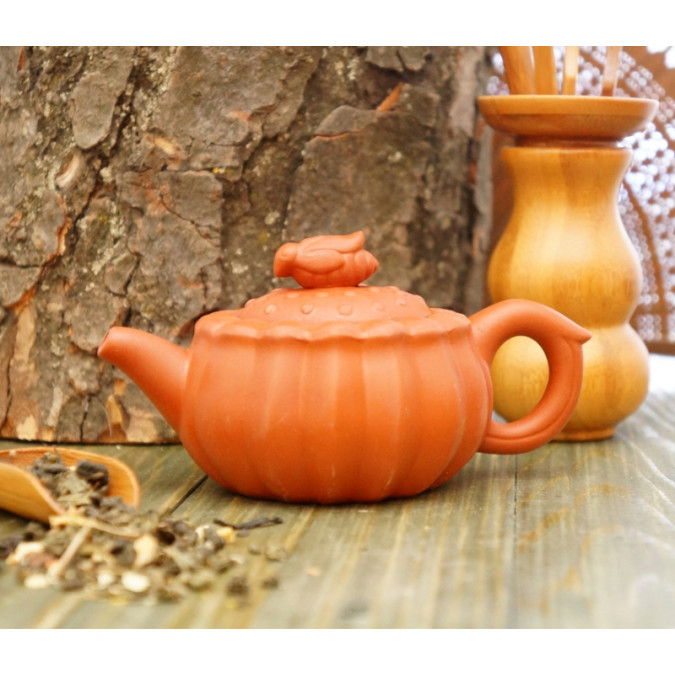
Clay teapot Isin 120ml.
- Nova Poshta and Ukrposhta nationwide
- Delivery in 1–7 days
- Self-pickup in Odesa by arrangement
- Cash on delivery
- Bank transfer
- Inspected and carefully packed before shipping
- Exchange and return within 14 days
The small city of Yixing in Jiangsu province is called the ceramic capital of China. The local ceramics are thin-stone products made of colored clays that do not allow water to pass through in an unglazed state. The beginning of ceramic production in this area, rich in clay, is lost in ancient times, and few of the oldest products have been preserved. According to the legend, the beginning of production was laid about 400 BC, when a major official from the state of Yue named Fan Li created workshops here, for which he was nicknamed the Prince of Red Pottery (Tao Zhugong). During the Song Dynasty, Yixing ceramics went beyond Isin, and during the Ming Dynasty it was already popular. "Purple sand" pottery is a common name for products made from three types of clay mined in the Yixing region, namely red, purple and green. Since the region of their occurrence is quite extensive and contains a variety of layers, and different temperatures and times are used during firing, the variety of colors and shades of finished teapots is so great that it is amazing. Therefore, when you find somewhere an unnaturally blue or green teapot, do not think that it was painted with some kind of dyes. Clay itself, like a chameleon, changes its colors in the skillful hands of masters. In general, we can talk about five features of teapots made from Yixing clay, namely:
1. It does not affect the aroma and taste of brewed tea. That is why tea utensils made from it are used for brewing tea with the aim of subsequently tasting its original aroma and taste, as well as contemplating the color resulting solely from the interaction of water with tea leaves.
2. It is able to “absorb” tea infusion, and also accumulate “tea scale” in the process of constant brewing. And it is this ability that allows old teapots to show us the wonderful “turning water into tea”.
3. It is easy to wash. If the kettle is not used for a long time, it is difficult to avoid foreign odors, which are absolutely unacceptable if you really want to brew a good teapot. To eliminate these odors, it is enough to pour boiling water into the teapot two or three times, and then rinse with cool water, and it is ready for use again without a possible change in the natural aroma of tea.
4. Teapots made of high-quality clay have very low thermal conductivity and slow heat dissipation, due to which the tea inside the teapot cools rather slowly, and you can always take the teapot handle without fear of getting burned.
5. And finally, it is very heat resistant, and if you pour warm water into the teapot and then boil tea in it, you don't have to worry about the teapot breaking.
6. One of the best practical characteristics of Yixing teapots, which allows you to make the same “miraculous transformation”, is associated with a fairly high porosity. After all, it is the pores that provide good air circulation. The metal oxides contained in purple clay in large quantities form many accumulations in its microstructure, which is why Yixing teapots have pores of a dual nature. In other words, such clay launches the components contained in tea into itself and stores them there, like honey in a honeycomb. In addition, many types of Yixing clays have good plasticity and adhesion, making them very suitable for creating artistic elements and fine finishing. All these natural characteristics have made lilac clay exceptional for making beautiful teapots.
There are no reviews for this product.
No questions about this product.